Unlock the Potential of Your Law Firm Website: 5 Strategies for Maximum Sales”
- admin
- April 7, 2024
- Law Firm Marketing
- 0 Comments
The legal world. We all know it – steeped in tradition, a place where a firm handshake and a weighty legal precedent hold undeniable power. For generations, success has been built on reputation whispered through the corridors of courthouses and referrals passed down like heirlooms.
But here’s the thing: the world is changing, and fast. The legal landscape isn’t just about those grand courthouses anymore. There’s a whole new frontier out there, a digital one, buzzing with potential clients who don’t necessarily wear suits and carry briefcases.
In this new world, reputation and referrals are still gold, but they can easily get lost in the digital noise. This isn’t about throwing out tradition, though. It’s about taking that legacy and those core values, and using the power of the modern age to amplify them. It’s about making sure the law firm not only survives, but thrives, in this new, tech-driven era.
Importance of a High-Performing Website for Law Firms

A highly optimized and high-performance law firm website is crucial for the success of a law firm’s marketing strategy as it directly influences how clients perceive and interact with the firm. Here are some key reasons why a law firm website should be highly optimized and high-performing:
First Impression: A well-designed website creates a positive first impression and instills confidence in potential clients. It should have a professional and clean design that reflects the law firm’s branding.
Search Engine Optimization (SEO): A law firm website needs comprehensive SEO to achieve strong organic search engine rankings. This involves keyword research, on-page and off-page optimization, and user-friendly navigation.
Mobile-Friendly and Responsive Design: With over 55% of total browser usage on mobile devices, a law firm website should be designed to be mobile-friendly and responsive. This ensures a professional and functional experience for visitors on any device.
Clear Legal Practice Areas: Clearly stating the law firm’s practice areas helps potential clients understand the types of cases the firm handles. This avoids confusion and ensures that clients seeking specific legal services can easily find the information they need.
Calls-to-Action and Contact Info: Including clear calls-to-action throughout the website prompts visitors to take desired actions, such as scheduling a consultation. Additionally, prominently displaying the law firm’s contact information on every page makes it easy for visitors to get in touch.
High-Quality Images and Attorney Profiles: Using high-quality images that align with the law firm’s branding and showcasing attorney profiles with professional headshots, experience, and qualifications helps build trust and rapport with potential clients.
Educational Content and Video: Providing educational content through a blog, FAQs, and white papers establishes the law firm as an authority in its field and builds trust with prospects. Additionally, incorporating video content on the website helps reach an audience that prefers consuming information through videos.
Website Speed and Security: Optimizing website speed is crucial for user experience and search engine rankings. Slow-loading websites can lead to higher bounce rates and lower conversion rates. Additionally, ensuring website security with SSL certificates protects client data and improves search engine rankings.
#1. Optimize Your Website for Search Engines
Optimizing your website for search engines is crucial for improving its visibility and attracting organic traffic. By implementing effective search engine optimization (SEO) strategies, you can enhance your website’s chances of ranking higher in search engine results pages (SERPs). In this blog section, we will explore some key steps to optimize your website for search engines.
1.1. Conduct Keyword Research:
Start by identifying relevant keywords and phrases that your target audience is likely to search for.
Use keyword research tools to discover popular and low-competition keywords.
Incorporate these keywords naturally into your website’s content, including titles, headings, meta descriptions, and body text.
1.2. Optimize On-Page Elements:
Ensure that your website’s title tags, meta descriptions, and URLs are concise, descriptive, and contain relevant keywords.
Use header tags (H1, H2, etc.) to structure your content and make it easier for search engines to understand.
Optimize your images by using descriptive alt tags and compressing their file sizes for faster loading times.
1.3. Improve Website Speed and Performance:
Optimize your website’s loading speed by minimizing file sizes, leveraging browser caching, and using content delivery networks (CDNs) [1].
Compress images and enable browser caching to reduce load times.
Regularly monitor and fix broken links to enhance user experience and maintain search engine crawlability.
1.4. Create High-Quality and Engaging Content:
Develop informative, unique, and engaging content that provides value to your target audience.
Incorporate relevant keywords naturally into your content, but avoid keyword stuffing.
Use headings, subheadings, and bullet points to make your content scannable and easy to read.
1.5. Build High-Quality Backlinks:
Earn backlinks from reputable and authoritative websites in your industry. Guest posting, content promotion, and influencer outreach can help you acquire quality backlinks. Focus on building a diverse backlink profile with a mix of anchor texts and link sources. It is very important to invest in this properly by collaborating with a skilled digital agency that will provide you with sterling work on this technical work.
#2. Enhance User Experience and Navigation

For any credible and self-respecting law firm that really takes its online marketing seriously, user experience (UX) is non-negotiable. We can’t stress out the importance of user-friendly website design and how it impacts visitor engagement, retention, and ultimately, conversion rates.
Beyond aesthetics, we would love to advise you to work with your digital agency to focus into the technical aspects of website performance, including optimizing speed and responsiveness. A sluggish website not only frustrates visitors but also negatively impacts search engine rankings—a double blow to your firm’s online visibility. Which is why you need dedicated skill to perform this task so you focus on growing your business doing what you love doing.
User experience (UX) and navigation are crucial aspects of any website or application. A well-designed navigation system can greatly enhance the user experience, making it easier for users to find what they are looking for and navigate through the content. In this blog post, we will explore some best practices to enhance user experience and navigation.
2.1. Clear and Organized Navigation Structure:
Ensure that your navigation structure is clear and organized, with a logical hierarchy of pages and categories .
Use categories and subcategories to group related content together, making it easier for users to find what they need.
Consider using breadcrumbs to provide users with a clear path back to the main categories or homepage.
2.2. Visible and Accessible Menus:
Make sure that your menus are easily visible and accessible to users. Avoid hiding menus or using tiny menu icons on large screens. Place menus in familiar locations where users expect to find them, such as the top of the screen or left rail. Use interactive menu links that are visually distinct and clearly clickable.
2.3. Consistent and Responsive Design:
Maintain consistency in your navigation design across all pages of your website or application. This includes using consistent menu styles, fonts, and colors. Design responsive layouts that adapt to different screen sizes and devices. Optimize the navigation for each device to provide the best user experience.
2.4. Utilize Visual Communication:
Leverage visual elements such as images, graphics, or colors to aid users in understanding the menu options. Ensure that the visual design establishes a clear hierarchy of primary, secondary, and tertiary navigation items.
2.5. Tie Navigation with Business Priorities:
Align your website navigation with your business objectives. Direct users to the most important features for conversion and sales. Incorporate clear and compelling calls-to-action (CTAs) to guide users towards desired actions.
#3. Create Compelling Content

Content is king, especially in the legal marketing field and you need to make sure your content measures up to the best standards so you can stand out from competition. From blog posts to case studies, creating compelling content is essential for capturing the attention of your target audience and driving engagement. By following these best practices, you can create content that stands out and resonates with your audience.
3.1. Know Your Audience
Understanding your target audience is the first step in creating compelling content. Research and identify their demographics, interests, pain points, and preferences. Develop buyer personas to have a clear picture of who your content is intended for.
3.2. Define Clear Objectives
Establish clear objectives for your content marketing strategy. Whether it’s increasing brand awareness, driving website traffic, generating leads, or boosting conversions, having a clear purpose will guide your content creation process.
3.3. Focus on High-Quality Content
High-quality content is key to success in a sea of online content. Ensure that your content is informative, well-researched, and well-written. Address your audience’s pain points, answer their questions, and provide unique insights. Use a mix of formats such as blog posts, videos, infographics, and podcasts to cater to different audience preferences.
3.4. Be Authentic and Transparent
Audiences appreciate authenticity and transparency. Establish a genuine connection with your audience by sharing your brand’s story, values, and beliefs. Avoid excessive self-promotion and focus on delivering honest, helpful, and unbiased information.
3.5. Incorporate Visuals
Visuals can significantly enhance the appeal and engagement of your content. Use high-quality images, infographics, and videos to complement your written content. Visuals help convey complex information effectively and make your content more shareable on social media platforms.
3.6. Utilize Storytelling
Incorporate narratives, personal experiences, or customer success stories into your content. Storytelling captivates audiences and creates emotional connections. It enables your audience to relate to your brand and message on a deeper level.
3.7. Engage with Your Audience
Encourage engagement by inviting your audience to leave comments, ask questions, or share their experiences. Respond promptly to foster a sense of community and show that you value their input.
#4. Implement Conversion Rate Optimization Techniques

Driving traffic to your website is only half the battle; the other half is converting those visitors into leads and clients.
For your law firm’s digital marketing strategy to work you need to realise that a website is more of your firm’s sales person. But just like dealing with any sales person, if after a brief introduction client up and leave without buying anything, you’re missing out on potential customers. This is where Conversion Rate Optimization (CRO) comes in. CRO is the process of strategically improving your website to increase the percentage of visitors who take a desired action, whether it’s making a purchase, signing up for a newsletter, or downloading a white paper.
4.1. Why is CRO Important?
Think about it this way: Every website visitor represents an opportunity. By implementing CRO techniques, you can:
Boost sales and leads: Convert more website visitors into paying customers or qualified leads.
Improve ROI (Return on Investment): Maximize the return you see from your marketing efforts.
Enhance user experience: Create a website that is not only visually appealing but also easy to navigate and use.
Gain valuable insights: Learn more about your target audience and their behavior on your website.
4.2. Getting Started with CRO
Here are some key steps to take on your CRO journey:
Define your conversion goals: What specific actions do you want visitors to take on your website?
Analyze your website traffic: Use website analytics tools to understand where visitors are coming from, what pages they visit, and how long they stay.
Identify conversion roadblocks: Are there any confusing forms, slow loading times, or unclear calls to action (CTAs) that might be hindering conversions?
Prioritize A/B testing: Test different variations of your website elements (e.g., headlines, CTAs, page layouts) to see which ones perform better.
Focus on user experience: Make sure your website is mobile-friendly, easy to navigate, and provides valuable content that resonates with your target audience.
4.3. CRO Techniques to Implement
Here are a few specific CRO techniques you can put into action:
Craft compelling CTAs: Use strong verbs and clear language to tell visitors what you want them to do next.
Optimize for mobile: A significant portion of web traffic comes from mobile devices. Ensure your website offers a seamless experience on all screen sizes.
Leverage social proof: Showcase positive testimonials, case studies, and customer reviews to build trust and credibility.
Offer limited-time promotions: Create a sense of urgency with special offers or discounts.
Personalize the user experience: Tailor content and offers based on user behavior and preferences.
Remember, CRO is an ongoing process. By continually testing, analyzing, and iterating, you can refine your website and turn more visitors into loyal customers.
Ready to take your website to the next level? Collaborate with a skilled digital agency and start implementing these CRO techniques and watch your conversion rates soar!
#5. Optimise Contact Forms on your Website
Contact forms are a crucial component of any website, serving as a direct line of communication between businesses and potential customers. However, simply having a contact form on your website is not enough. To maximize engagement and conversions, it is essential to optimize your contact forms. In this blog section, we will explore best practices to help you optimize your contact forms and turn inquiries into conversions.
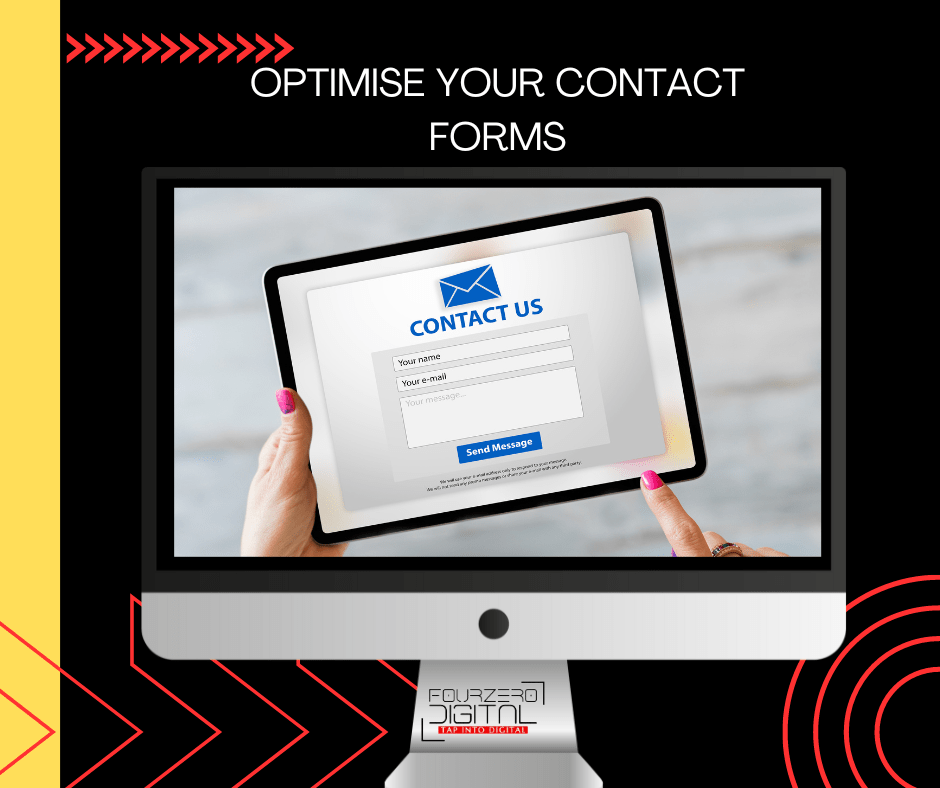
It is important to make sure that the contact form on your website is connected to the admin email for several reasons:
5.1. Efficient Communication: Connecting the contact form to the admin email ensures that any inquiries or messages submitted through the form are immediately sent to the designated email address. This allows for prompt and efficient communication between the website visitors and the website owner or administrator.
5.2. Streamlined Workflow: By receiving contact form submissions directly to the admin email, you can easily manage and organize all incoming messages in one central location. This helps to streamline your workflow and ensures that no inquiries or messages are missed or overlooked.
5.3. Quick Response Time: When the contact form is connected to the admin email, you can respond to inquiries and messages in a timely manner. This helps to provide excellent customer service and improves the overall user experience on your website.
5.4. Missed Leads and Inquiries: This is the most significant consequence. Without a proper connection, any messages submitted through the form will disappear into the void. You’ll miss out on potential customers reaching out for quotes, questions, or wanting to learn more about your services.
5.5. Wasted Time and Frustration: Imagine someone filling out a contact form with a detailed message or inquiry. If it doesn’t reach you due to a disconnected email, it creates a frustrating experience for both them (no response) and you (lost opportunity).
5.6. Delays in Communication: Even if you discover the issue and find the messages elsewhere, a delay in response reflects poorly on your professionalism. Timely communication is essential for building trust and rapport with potential customers.
In conclusion
optimizing your website for high sales performance needs you to follow a series of good practices aligned on this blog post. If you were to follow these exact steps you would find out that your marketing boosts your sales growth in no time. It is important to keep up to date with trends in the market but for you to do that effectively you need to collaborate with an experienced digital agency who will take care of these tasks whilst you focus on growing your law firm and do what you are good at doing- making law! Implementing conversion optimization techniques is essential for maximizing conversions and improving the user experience on your website. Additionally, connecting your contact form to the admin email ensures efficient communication, streamlined workflow, quick response times, and enhanced security and privacy. By following these best practices, you can create an engaging and user-friendly contact form that turns inquiries into conversions, ultimately boosting the success of your online business.
Related Posts